

Ensuring Customer Safety/Food
Ⅰ. Corporate Governance
Decision-Making Structure
Hanmi Science operates a food safety management system with the CEO as the top decision-maker to systematically manage the safety and quality of food products. The CEO has final approval authority over strategies to ensure customer safety in the food sector. The Head of the Consumer Health Division, who oversees food customer safety, manages and approves food safety objectives, annual action plans, key policies, and directions, and the Songtan Plant's Quality Development Team is responsible for food safety management within the manufacturing plant. They manage key aspects related to food safety during the manufacturing process, identify hazards throughout the entire process, and proactively eliminate them to ensure food safety at the manufacturing stage. Additionally, the QA Manager of the Head Office's Strategic Marketing Group is responsible for food safety management, including that of external manufacturers. Beyond the manufacturing stage, they manage the review and monitoring of food advertisements and various publications to ensure that accurate and reliable food information is provided to consumers. Through this decision-making structure, Hanmi Science systematically manages all processes related to food safety and pursues continuous improvement activities with customer safety as its top priority.
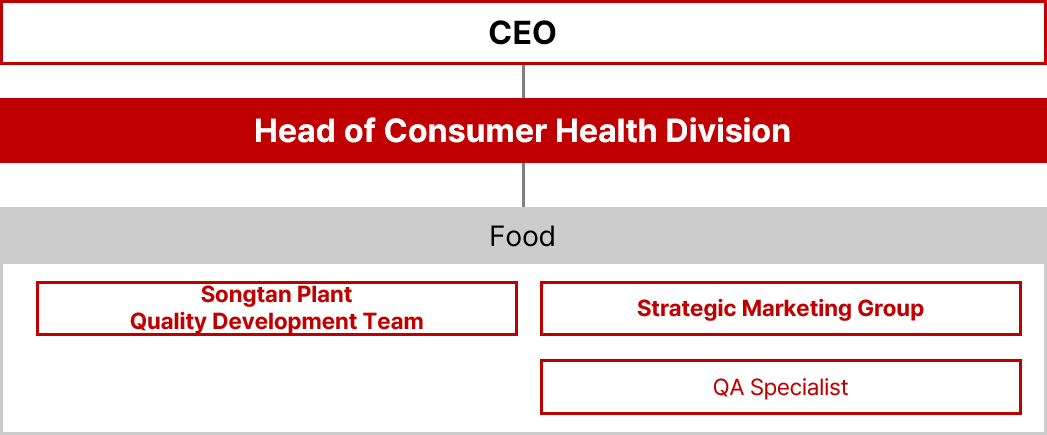
Roles and Responsibilities
Category | Key Roles and Responsibilities |
CEO | ㆍFinal approval of customer safety assurance strategies |
Head of Consumer Health | ㆍDecision-making on food and cosmetic safety-related matters |
Songtan Plant | ㆍCollecting, operating, and monitoring key food safety matters within manufacturing plants, identifying and eliminating hazards |
Strategic Marketing Group | ㆍCollecting, operating, and monitoring key food safety matters within external manufacturers, identifying and eliminating hazards |
Mandatory Professional Training
Target Audience | Frequency | Training Content |
Quality Development Team Leader | 1st Time Only | ㆍHACCP Team Leader Training |
Quality Development Team Leader | Once a year | ㆍHACCP Regular Training |
Ⅱ. Strategy_Risk and Opportunity Identification
Hanmi Science identifies key risks and opportunities that can significantly impact stakeholders and sustainability related to ensuring customer safety, based on the results of IRO analysis, and continuously strives to establish effective response measures based on this.
RISK | |
|---|---|
Occurrence of administrative measures due to product quality issues | |
Characteristics of Impact | Potential Impact |
Affected Stakeholders | Customers, Government, and Related Institutions |
Severity of Impact | Scale ■■■□□ Scope ■■■■□ Recoverability ■■■□□ |
Expected Financial Impact | Likelihood ■■■□□ Scale ■■■■□ |
Impact on the Company | ㆍIncreased risk of customer safety incidents |
Company's Response | ㆍUtilization of a management system to ensure safe and transparent dietary practices |
OPPORTUNITY | |
|---|---|
Operating a rapid communication system for customer protection | |
Characteristics of Impact | Actual Impact |
Affected Stakeholders | Customers, Government, and Related Institutions |
Severity of Impact | Scale ■■■■□ Scope ■■■■□ |
Expected Financial Impact | Likelihood ■■■■□ Scale ■■■■□ |
Impact on the Company | ㆍSecuring trust from stakeholders, including customers, and strengthening the company's responsible management capabilities |
Company's Response | ㆍData-driven process improvement through VOC and SR management systems |
Ⅱ. Strategy_Risk and Opportunity Response Plan
Utilization of a management system to ensure safe and transparent dietary life
Food Traceability Management
For health functional foods and foods for special dietary uses among the products operated by the company, food traceability management is implemented. The Food Traceability Management system is provided by the Ministry of Food and Drug Safety, and it is a system that records and manages traceability information at each stage, from food manufacturing and processing to sales. Hanmi Science provides transparent information to consumers through this system and ensures customer safety by implementing swift distribution blocking and recall measures if issues arise concerning the safety of the respective food products.
Stage-by-stage Quality Management System
To deliver safe food to consumers, we operate an advanced quality management system at the manufacturing and distribution stages. We prevent unintentional food contamination that may occur in the supply chain and proactively identify and address risk factors arising during the distribution process, thus growing into a company trusted by customers.
Manufacturing | Goals | Securing Safe and Sustainable Raw Materials |
Key Activities | ㆍOperation of supplier quality audit process | |
Management Indicators | ㆍSupplier ratings and evaluation cycle | |
Expected Effects | ㆍStrengthening supply chain transparency | |
▼ | ||
Distribution Stage | Goals | Delivery of Safe Products and Goods |
Key Activities | ㆍStrengthening temperature and hygiene standards within the distribution channels | |
Management Indicators | ㆍRecall occurrence rate, response and disposal indicators | |
Expected Effects | ㆍEnsuring quality consistency in the distribution process |
<Supplier Quality Audit Process>
Once the supplier selection is complete, supplier validity verification is carried out, followed by annual evaluations twice a year after contract completion. Our company evaluates suppliers based on assessment sheets that include standards such as HACCP, GMP, mandated by the Ministry of Food and Drug Safety, and FSC22000, a standard of GFSI (Global Food Safety Initiative). We ensure the manufacturing safety of suppliers through regular inspections (1-2 times a year) and special verifications (in case of urgent risks such as discovery of claims or non-conforming elements). From 2026, we aim to establish a system that allows for more precise evaluation of supplier quality and safety levels and proactive risk management by strengthening audit standards, segmenting the existing 2-tier partner audit grading system into 3 tiers.

Administrative Sanctions Status in 2025
Product | Content | Administrative Sanction | Action Taken |
|---|---|---|---|
4 items including | Failure to provide 9 cases of product release | Corrective Order | Daily inspection conducted by the head of |
High-level Hygiene Management through SIG Aseptic Equipment Process Operation
Hanmi Science maintains the quality consistency of its beverages by utilizing 'SIG Aseptic' equipment, a sterilization system with global competitiveness. To maintain a high level of hygiene management from raw material input to product packaging, the company has obtained 7 HACCP certifications by utilizing HACCP (Hazard Analysis and Critical Control Points) and its own hygiene SOPs (Standard Operating Procedures), thereby establishing a safe production environment. By identifying risks and opportunities that may arise during the process using SIG Aseptic equipment, and by establishing corresponding response plans and utilization strategies, process efficiency and quality safety are achieved.
Risks, Opportunities, and Response Measures that may arise from SIG Aseptic Equipment Process Operation
Risks | Response Measures | |
Potential for process contamination | ㆍPeriodic aseptic filling verification | |
Poor equipment cleaning | ㆍEstablishment and verification of cleaning | |
Opportunities | Response Measures | |
Enhancing product quality reliability | ㆍPackage design emphasizing | |
Introduction of digital quality management system | ㆍQuality data-driven improvement | |
Data-driven Process Improvement through VOC and SR Management System
We strengthen customer-centric product and service quality through VOC (Voice of Customer) and SR (Service Request) management systems. We collect VOC data through various channels and operate an SR channel to strengthen inter-departmental communication, promptly reflecting and processing customer feedback. Additionally, we enhance process quality by analyzing collected VOC and SR data, and ensure quality stability through process investment and improvement of key facilities.
VOC·SR Management System
Category | Key Activities | Management System | Key Achievements | Future Plans |
|---|---|---|---|---|
VOC | ㆍCollection of customer | ㆍOperation of a group-integrated call center | ㆍProducts 0.35ppm, | ㆍReflecting VOC improvement results |
SR | ㆍService requests and quality | ㆍOperation of an SR sharing channel within the | ㆍSR monthly average | ㆍEnhancing SR statistics management |
<Group Call Center Operation>
As part of its VOC collection system, Hanmi Science established a group-wide integrated call center in 2014. By listening to various consumer experiences and opinions related to products sold by Hanmi Science, such as packaging, consumption, and damage, and reflecting these in its process investment priorities, the company practices customer satisfaction.
<Group Call Center Reception Volume>
Category | Unit | 2023 | 2024 | 2025 |
Total Customer Interactions | Cases | 66,890 | 62,906 | 63,689 |
Hanmi Science | 8,790 | 6,716 | 5,887 | |
Online Pharm | 45,180 | 45,555 | 47,076 | |
Hanmi Pharmaceutical | 12,920 | 10,635 | 10,726 |
<2025 Hanmi Science Major Customer Feedback Received and Actions Taken>
Claim Type | Product Name | Details | Action Taken |
|---|---|---|---|
Packaging | Chueokui Mini Tenten Matchu | Negative consumer experience due to poor product sealing. | Equipment reassembly and replacement completed for stronger sealing. |
Energy Gold Caffeine 100mL | Cap spinning loose and detaching. | Prevention of outer cap detachment completed by reinforcing inner cap coating, and related process investment completed. | |
Leakage | Kyungbang Galgeun-tang | Leakage of liquid observed internally | Additional tests related to leakage completed |
Poor storage conditions | Premium Recipe 175mL | Outer box damage due to poor storage at the point of sale | Request completed to cool sufficiently before external storage to prevent internal temperature differences during storage |
III. Risk Management
Risk and Opportunity Monitoring | Period | Target | Method | Oversight |
VOC Handling Process and Policy | Ongoing | All products | Receipt Initial Response Secondary Response Closure | Strategic Marketing |
Food Safety Korea Monitoring | Violations | Internal DB check of Food Safety Korea and frequent verification via KakaoTalk notifications | Strategic Marketing |
Ⅳ. Indicators and Goals
Key Indicators | 2025 Target | 2025 Performance | Achievement |
|---|---|---|---|
Product quality issues and | Achieve ZERO food traceability omissions | Achieve 100% food traceability | Achieved |
Achieve 100% improvement rate for corrective actions issued during inspections | 100% completion of corrective actions for identified issues | Achieved | |
Achieve 100% inspection of our entrusted/consigned companies | 100% completion of twice-yearly inspections | Achieved | |
Claim reduction and CS logic establishment | Achieve 20% claim reduction (19.54ppm) and establish CS scripts/compensation plans | Achieved | |
Head office food traceability automation introduction | Automation introduction completed | Achieved | |
Establish QMS (Quality Management System) for all products before operation | 100% completion of QMS (Quality Management System) establishment for all products before operation | Achieved |
Key Indicators | 2026 Target | Mid-to-Long-Term Plan (2030) |
|---|---|---|
Product quality issues and | Maintain ZERO food traceability omissions at the head office | Introduction of food traceability management system automation at the Songtan Plant |
Reflect global standards in supplier inspection details, achieve 100% improvement rate | Strengthen global competitiveness through continuous global standard updates and application | |
Achieve 100% entrusted/consigned company inspections and 100% improvement rate for issued corrective actions | Maintain 100% entrusted/consigned company inspections and promote regular supplier meetings | |
Advance CS logic reflecting consumer feedback | Establish an enhanced CX management system through continuous template sophistication | |
Advance QMS (Quality Management System) for all products before operation | Stabilize new product quality through the introduction of Q-gate (Quality Gate) |