
Biodiversity Conservation
Hanmi Science recognizes the restoration of natural ecosystems and biodiversity conservation as a material sustainability issue for our company. During the course of our operations, we will proactively prevent factors that threaten biodiversity, and in case of damage, we will restore and regenerate to offset biodiversity loss. We continue activities related to natural ecosystem protection and biodiversity conservation. Furthermore, we will strive to apply these efforts not only to all our business sites but also throughout the entire supply chain connected by our stakeholders.
Biodiversity Performance and Goals
2025 Performance | 2026 Targets |
|---|---|
· Planted 912 trees in Hanmi Green Forest | · Plant over 1,000 trees in Hanmi Green Forest |
· Participated in 5 environmental clean-up activities, including the removal | · Participate in over 5 environmental clean-up activities |
Environmental Protection Activities
BEE Happy project
The decline in bee populations due to climate change has emerged as a critical social issue that could lead to ecosystem collapse. In response, Hanmi Group operates a program for bees, which are a vital link in natural ecosystem restoration and biodiversity conservation. The BEE Happy project runs an apiary development program to increase bee populations, and for its smooth operation, an MOU was signed with the Korea Beekeeping Association in 2022, operating 10 bee colonies at the corporate apiary. In 2025, high-quality wildflower honey was produced through the apiary development project. This honey underwent quality inspection according to honey standard specifications through the Apicultural Products Research Institute, and 1,080 bottles were donated to 'On-gi Chang-go' (Warmth Warehouse) stores 1 and 2, a non-profit shop for marginalized communities. The pollination value of bees in response to climate change is 47.4 times* that of honey production, which is because the beekeeping industry provides public benefits beyond economic value, such as ecosystem conservation and pollination of other crops. The honey produced through the BEE Happy project has an economic value of KRW 8 million, but when converted into public benefit value for society and the environment, it is a program that generates an impact of over KRW 380 million.
Qualitative Effects | ㆍRestoration of bee ecosystems | Honey Production Value: KRW 8 million |
|---|---|---|
Social Value | ㆍProvision of public benefit values such as ecosystem | Economic Value of Pollination |
Creation of Hanmi Green Forest
To promote carbon neutrality and biodiversity conservation, since 2021, we have been creating the Hanmi Green Forest, planting trees and rare plants, and striving to preserve the ecosystem. Starting with the creation of Hanmi Green Forest No. 1 near Tongbok Stream in Pyeongtaek City for the conservation of the endangered species, the Parnassius stubbendorfii butterfly, 8 forests have been created to date, in conjunction with Pyeongtaek City and the Gyeonggi Southern Ecological Education Research Institute. In 2025, we planted 1 zelkova tree, 400 Aristolochia contorta plants, and 400 Hosta longipes plants at the Pyeongtaek Agricultural Ecological Park in two separate events, and 111 trees, including Celtis sinensis and Hydrangea paniculata, at Hambaeksan Central Park. The plantings are expected to absorb approximately 912 kg of carbon dioxide annually.
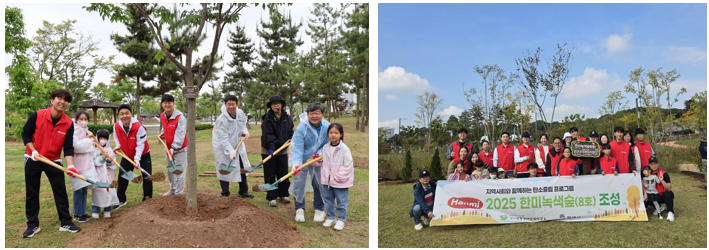
2025 Activity Area | 1,401 m2 |
2025 Trees Planted | 912 trees |
Cumulative Trees Planted | 3,342 trees |
|---|---|
Cumulative CO2 reduction contribution | 3,162kg |
Removal of Invasive Alien Species
As a corporate volunteer group, we participate in the Hangang Guardian Volunteer Group organized by the Future Han River Headquarters, to address local environmental and ecological issues, restore the growth foundation of native plants, and improve the Han River Park user environment. We conduct environmental cleanup and removal of invasive alien species such as Sicyos angulatus and Humulus scandens three times a year at Amsa Ecological Park in Gwangnaru Han River Park. In the future, we plan to continue participating in ecological environment improvement activities with our employees, their families, and friends.
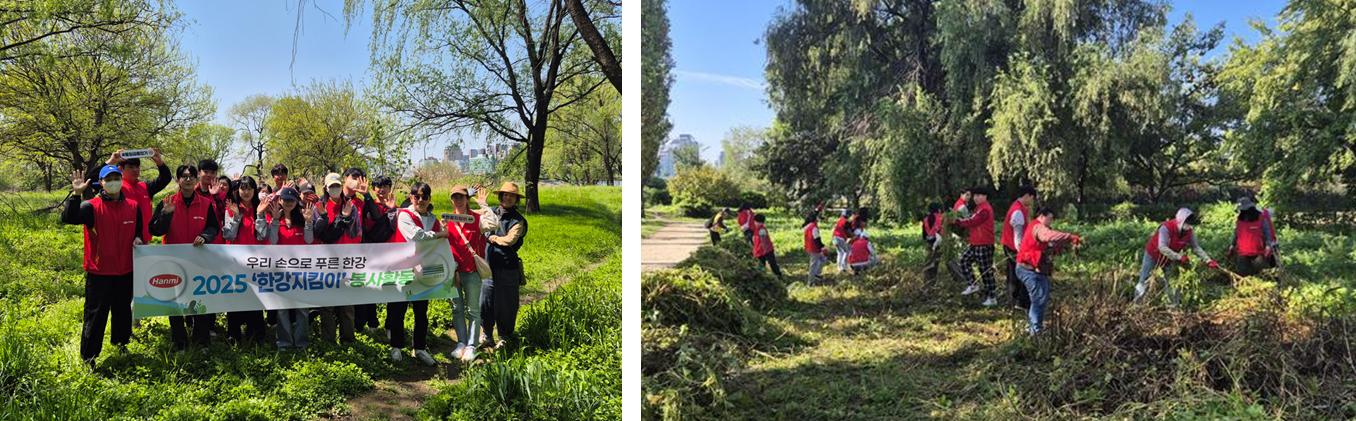
Activity Area | 2,981 m2 |