

Climate Change Response & Environmental Management
Ⅰ. Corporate Governance
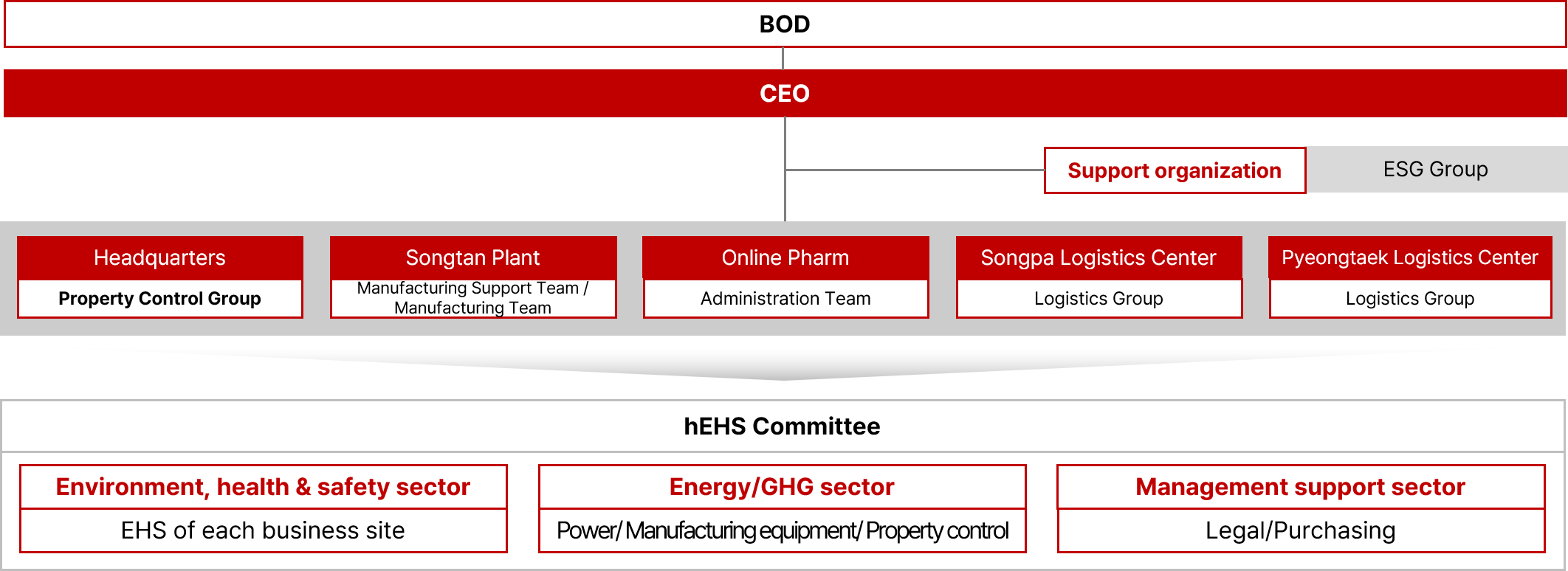
Hanmi Science has been operating an environment governance system centered around the Board of Directors since 2025 to establish a clear environmental management framework, including carbon neutrality and climate change response. In 2025, we reported our environmental strategy and mid-to-long-term plans, greenhouse gas emissions status (Scope 1·2), and key environmental performance to the Board of Directors. Going forward, we plan to continuously strengthen the Board's role and responsibilities in environmental management through the establishment of an ESG Committee under the Board.
Decision-Making Structure
Role of Dedicated Organization
Category | Roles |
|---|---|
Board of Directors | ㆍOverseeing major environmental management strategies and plans (regular reporting once a year) |
CEO | ㆍResponsibility for final decision-making on environmental management matters |
ESG Group | ㆍEstablishment of key environmental management strategies and plans |
hEHS Committee | · Review and examination of environmental management policies and plans related to greenhouse gases, water, wastewater, etc. |
Dedicated departments | ㆍImplementation of detailed environmental and greenhouse gas management activities |
ⅠⅠ. Strategy
ⅠⅠ-(1) Detailed Carbon Neutrality Strategy
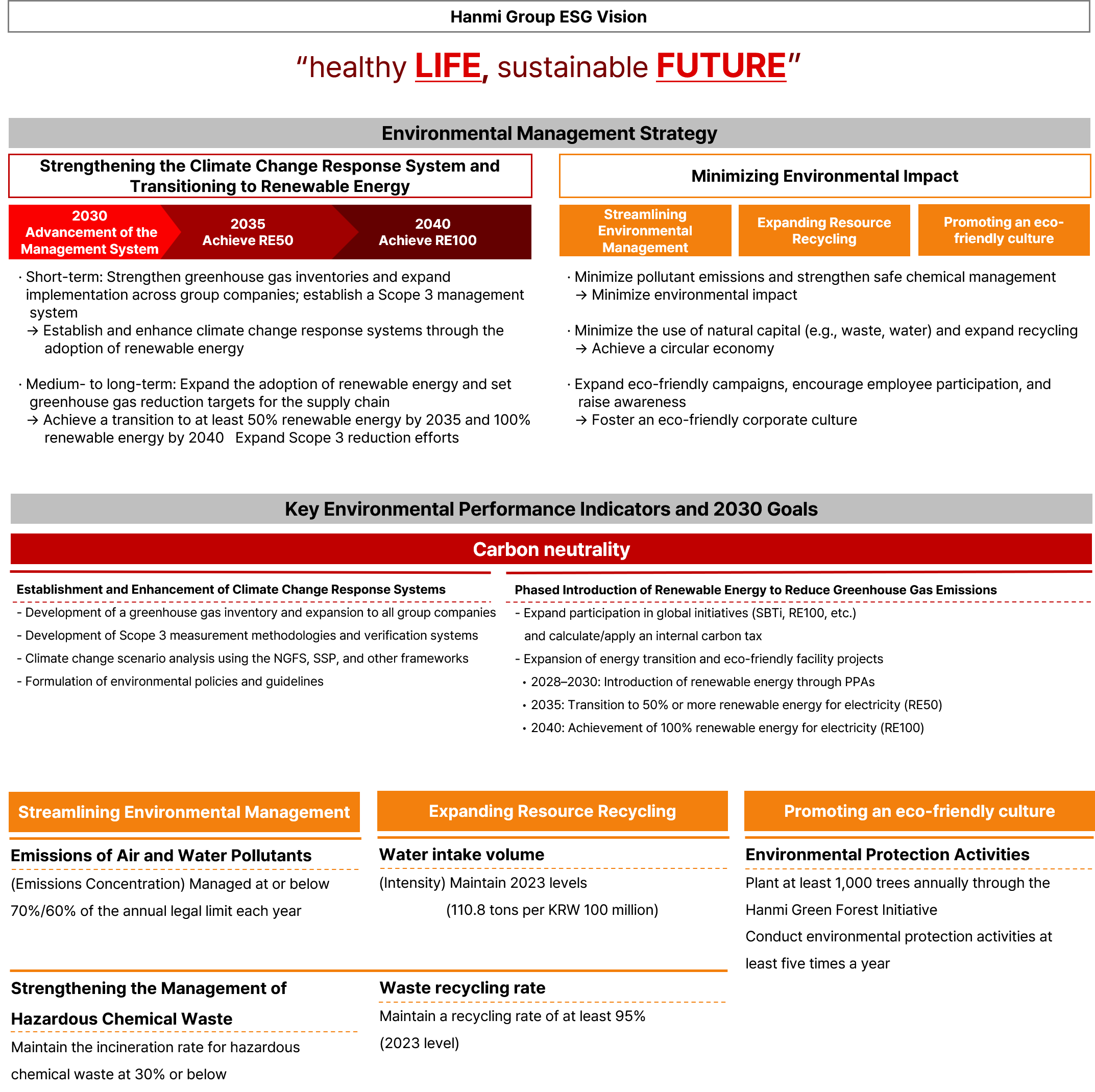
Hanmi Science plans to gradually build an environmental management system, including establishing a greenhouse gas inventory and calculating Scope 3 emissions in the short and medium term, to achieve 100% renewable energy conversion by 2040. Through this, the company plans to advance its decision-making structure, systematically identify and analyze climate change-related risks and opportunities, set detailed mid-to-long-term reduction targets, and establish a company-wide climate change response system to build a foundation for implementing environmental management. Moving forward, the company will sequentially review the introduction of renewable energy and investment in eco-friendly facilities, continuously striving to achieve its goals of introducing renewable energy by 2030, converting 50% to renewable energy by 2035, and 100% conversion by 2040.
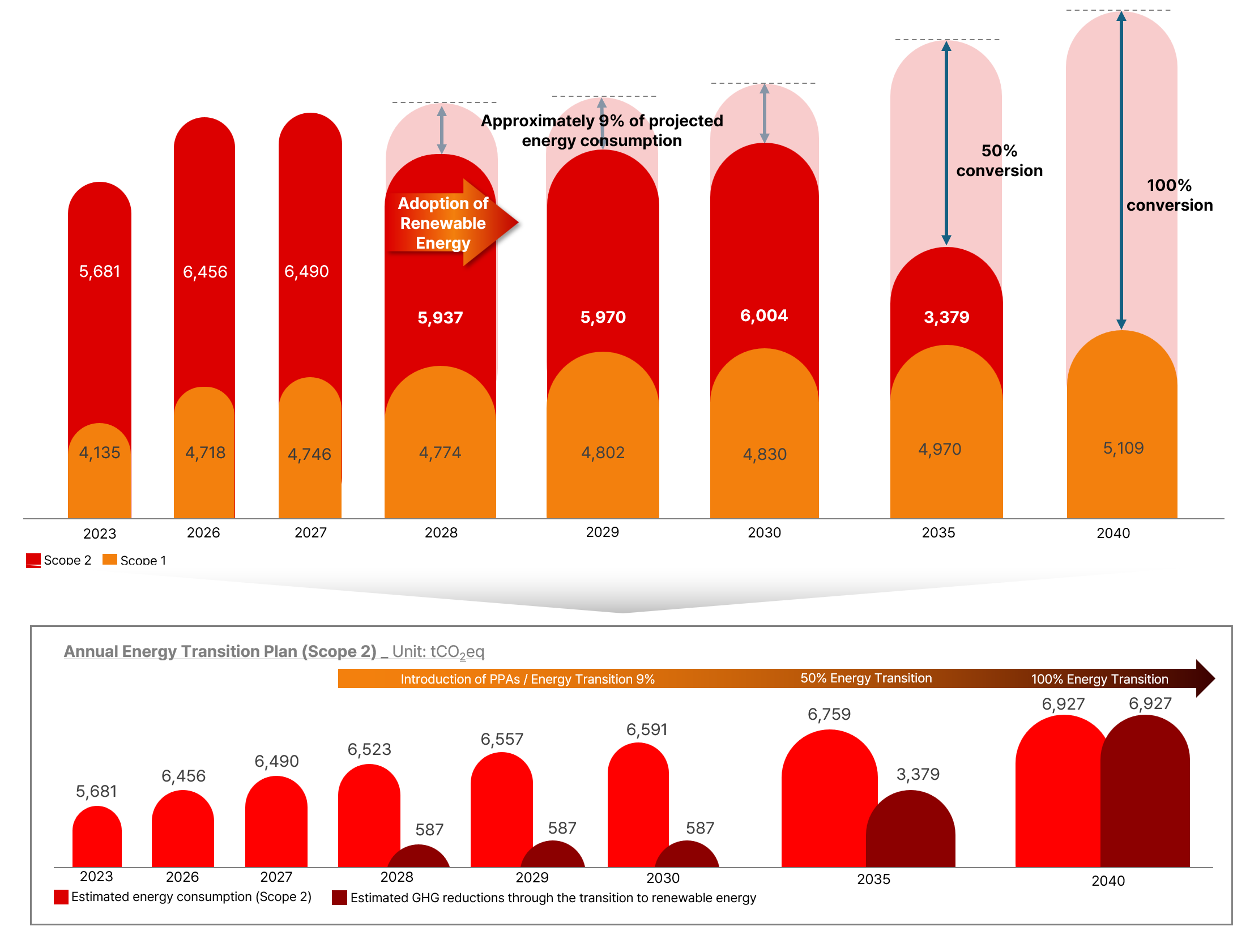
Hanmi Science Scope 1 & 2 Emissions Reduction and Renewable Energy Transition Roadmap
Hanmi Science has established a greenhouse gas (Scope 1&2) inventory management system since 2025 to systematically manage emission status. Currently, greenhouse gas emissions from the Songtan plant account for approximately 85% of total emissions. Therefore, in the short term, the company is focusing on the Songtan plant, reflecting increased operating rates, and establishing a BAU (Business As Usual) scenario and pursuing renewable energy-based energy transition. Accordingly, a carbon neutrality roadmap has been established, aiming for the introduction of renewable energy by 2030, 50% renewable energy conversion by 2035, and 100% conversion by 2040.
Furthermore, to enhance the carbon neutrality roadmap in the future, the company is considering 2023, immediately after the merger of Hanmi Science and Hanmi Healthcare, as the base year for greenhouse gas reduction. The company plans to gradually concretize its greenhouse gas reduction targets against the base year through process optimization and the introduction of eco-friendly facilities.
Category | Unit | 2026 | 2027 | 2028 | 2029 | 2030 | 2035 | 2040 |
|---|---|---|---|---|---|---|---|---|
BAU* | tCO2eq | 11,167 | 11,220 | 11,281 | 11,343 | 11,405 | 11,712 | 12,020 |
Amount of Renewable Energy Introduced | MW | 0 | 0 | 1 | 1 | 1 | 6 | 12 |
Renewable Energy Conversion Rate | % | 0% | 0% | 9% | 9% | 9% | 50% | 100% |
gas emission intensity
Hanmi Science Greenhouse Gas Emissions Status in 2025
Hanmi Science (including Online Pharm) greenhouse gas emissions total 10,836 tCO2eq. Scope 1 emissions, from sources such as boilers and gasoline, are 4,648 tCO2eq (43%), and Scope 2 emissions from electricity are 6,189 tCO2eq (57%). In the future, by measuring Scope 3, the company plans to more comprehensively understand the overall greenhouse gas emission structure across its business and enhance its mid-to-long-term reduction strategy.

Key Carbon Neutrality Activities in 2025
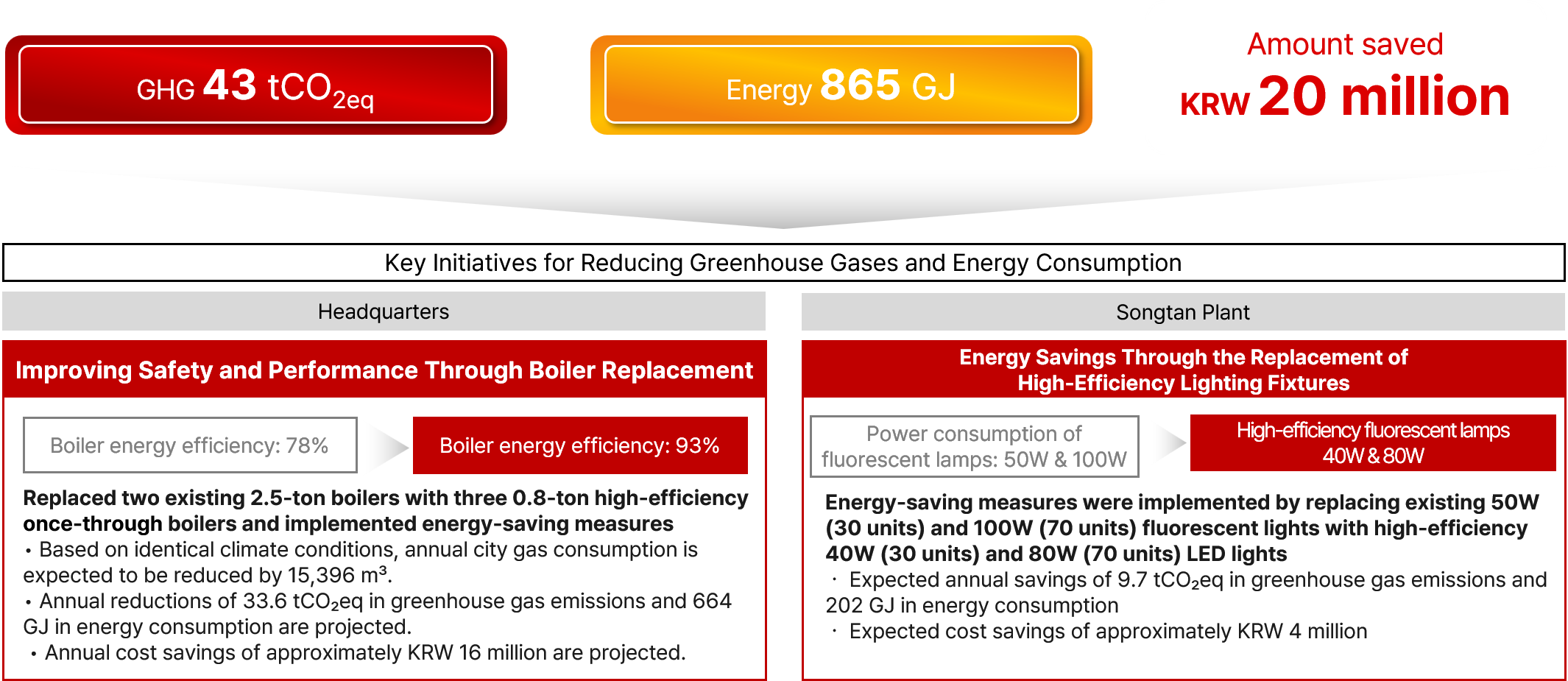
Hanmi Science is implementing greenhouse gas/energy reduction activities to reduce carbon emissions. Through reduction activities in 2025, the company expects to achieve a reduction effect of 43 tCO₂eq of greenhouse gases and 865 GJ of energy. Furthermore, in 2026, the company plans to continuously expand greenhouse gas reduction activities by introducing electricity demand forecast monitoring and replacing high-efficiency chillers.
Estimated Annual Reduction from 2025 Reduction Activities
Ⅱ-(2) Minimizing Environmental Impact
Hanmi Science continuously monitors relevant environmental issues to systematically manage environmental impacts that may arise during production and office operations. Starting in 2025, key environmental management performance, including air and water pollutants, water usage, and waste, will be regularly reported to the Board of Directors, thereby strengthening management and oversight of environmental management. Particularly in waste management, the company consistently maintains a recycling rate of over 90% annually, continuously striving to expand resource circulation. In the future, the company plans to gradually establish an environmental management system through the formulation of an environmental policy and the introduction of an environmental management system.
Pollutant Management
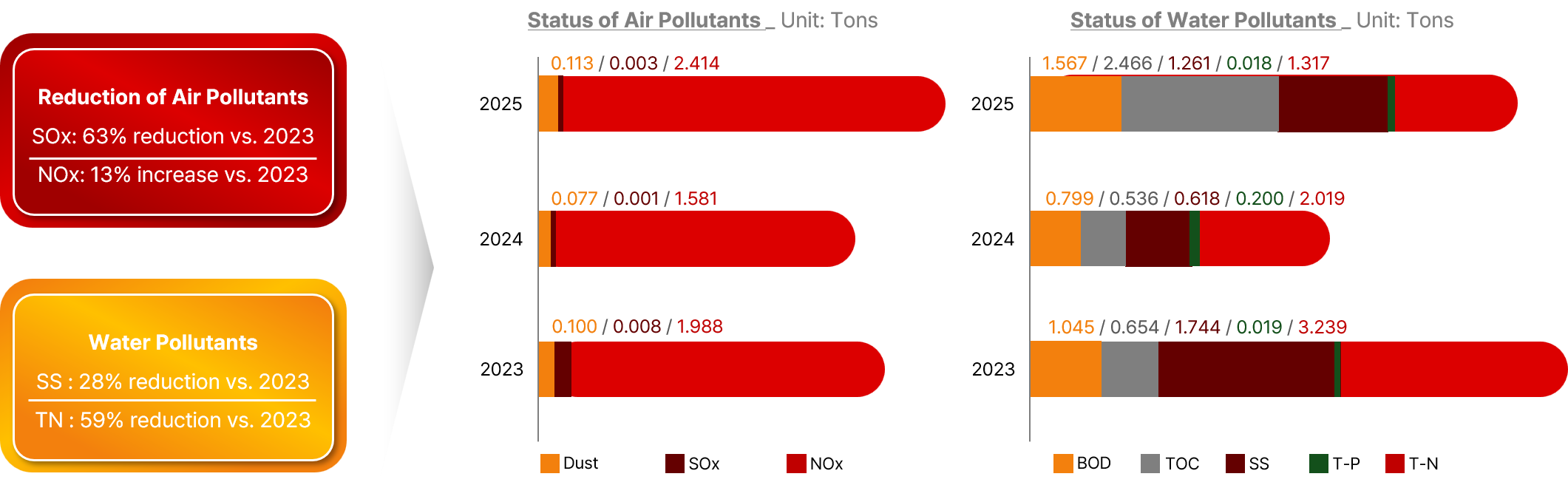
Hanmi Science's Songtan plant manages air pollutants by applying low-NOx burners to boilers to comply with emission standards for air pollutants generated from boiler combustion. In 2025, the headquarters replaced its boilers with high-efficiency once-through boilers to reduce fuel consumption, and the Songtan plant enhanced its pollutant management level by repairing external sludge hoppers. Through these activities, air and water pollutants were managed at levels below 70% and 60%, respectively, of the legal permissible standards.
Risk | Financial Impact (KRW 100M/year) | Countermeasures | |||
|---|---|---|---|---|---|
Content | Short-term | Mid-term | Long-term | ||
Increased pollutant generation due to | Increased pollutant | 2.11 | 2.14 | 2.23 | Monitoring for management |
Pollutant Management Status
Hazardous Chemical Management
Hanmi Science thoroughly complies with the obligations for hazardous chemical handlers as stipulated in relevant laws such as the 'Chemical Control Act,' and performs safety management based on standards for handling hazardous chemicals and facility management. To this end, we establish appropriate maintenance and safety accident prevention measures for hazardous chemical handling facilities and always keep disaster prevention equipment and neutralizing agents on hand. Furthermore, we conduct annual regular inspections of hazardous chemical handling facilities, including manufacturing/usage facilities and storage facilities, through accredited inspection agencies, and manage records of inspection results and implement subsequent safety measures.
Hazardous Chemical Usage Status
Category | Unit | 2022 | 2023 | 2024 | 2025 |
|---|---|---|---|---|---|
Hazardous Chemical Usage Volume | ton | 218 | 277 | 228 | 259 |
Waste Management
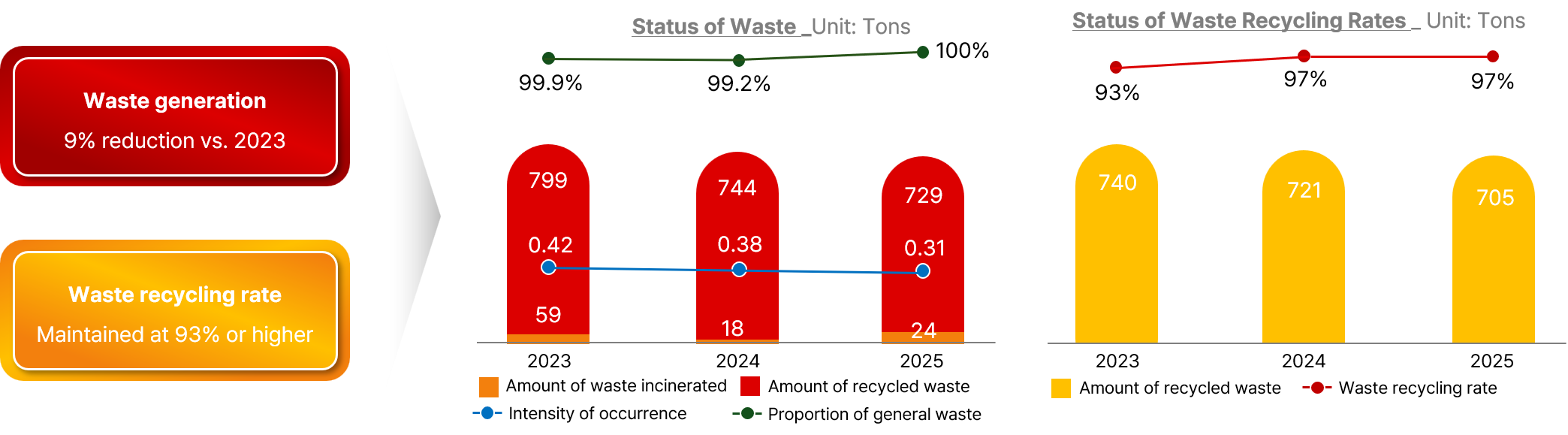
Hanmi Science thoroughly complies with waste management standards stipulated in relevant laws such as the 'Waste Management Act,' and operates on the principle of transparently recording and managing the entire process of generation, transportation, and treatment of general waste and designated waste (including hazardous substances) through the waste appropriate treatment system (Allbaro). The Songtan plant maintains a recycling rate of over 93% annually, and by stably managing DO·water temperature·and pH levels, it improved wastewater treatment efficiency, reduced sludge generation, and achieved an 8% reduction in waste generation compared to 2023. Furthermore, the headquarters signed a contract in 2025 for 100% recycling of all waste, processing 100% of the waste generated in that year.
Risk | Financial Impact (KRW 100 mil. /year) | Countermeasures | |||
|---|---|---|---|---|---|
Content | Short-term | Mid-term | Long-term | ||
Increased waste generation due | Increased waste | 0.61 | 0.62 | 0.65 | Maintain waste recycling rate |
Waste Management Status
Key Waste Impacts
Category | Generation | Impact | |
|---|---|---|---|
Songtan Plant | Wastewater Treatment Sludge | Wastewater Treatment | Marine pollution upon discharge |
Vegetable Residues | Product Manufacturing | Generation of greenhouse gases and environmental impact | |
Headquarters | Waste Synthetic Resin | Office and building operation process | Emission of greenhouse gases and microplastics during incineration |
Songtan Plant | |||
Status of Key Waste Recycling
Category | Recycling Treatment Details | |
|---|---|---|
Songtan Plant | Wastewater Treatment Sludge | Used for soil improvement |
Used in agricultural production activities | ||
Vegetable Residues | Used in agricultural production activities | |
Headquarters | Waste Synthetic Resin | Manufacture of intermediate processing waste |
Water Resource Management
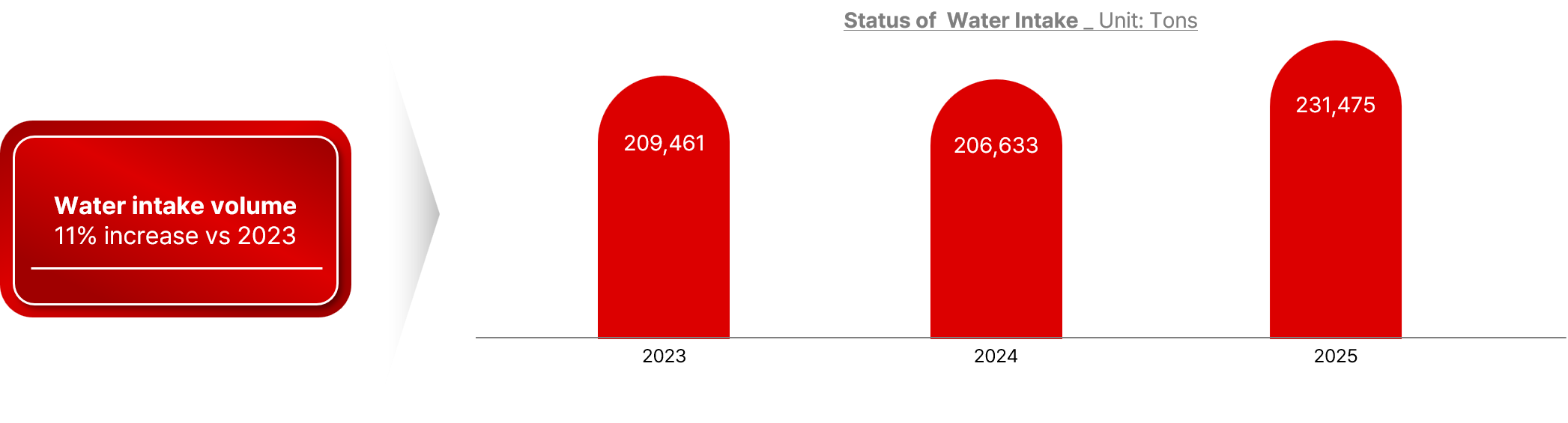
Approximately 95% of Hanmi Science's total water intake originates from the Songtan plant. The Songtan plant utilizes groundwater and tap water as its water sources, and to reduce water costs, it has obtained permits for groundwater development and use in accordance with the 「Groundwater Act」, ensuring the legal use of groundwater. To prevent groundwater pollution, regular water quality tests are conducted, and contaminants are removed through semi-annual water tank cleaning. Furthermore, by operating water softening facilities to pre-remove calcium and magnesium components from the water, and supplying it to manufacturing processes after a UV sterilization process, optimal water quality is maintained. Meanwhile, through collaboration with manufacturing processes, we are promoting continuous improvement activities to reduce water consumption by efficiently adjusting the number of CIP cleanings for each production item.
Water Withdrawal Status
Eco-friendly In-house Campaigns
Use of Reusable Cups in Cafeterias and Coffee Grounds Recycling
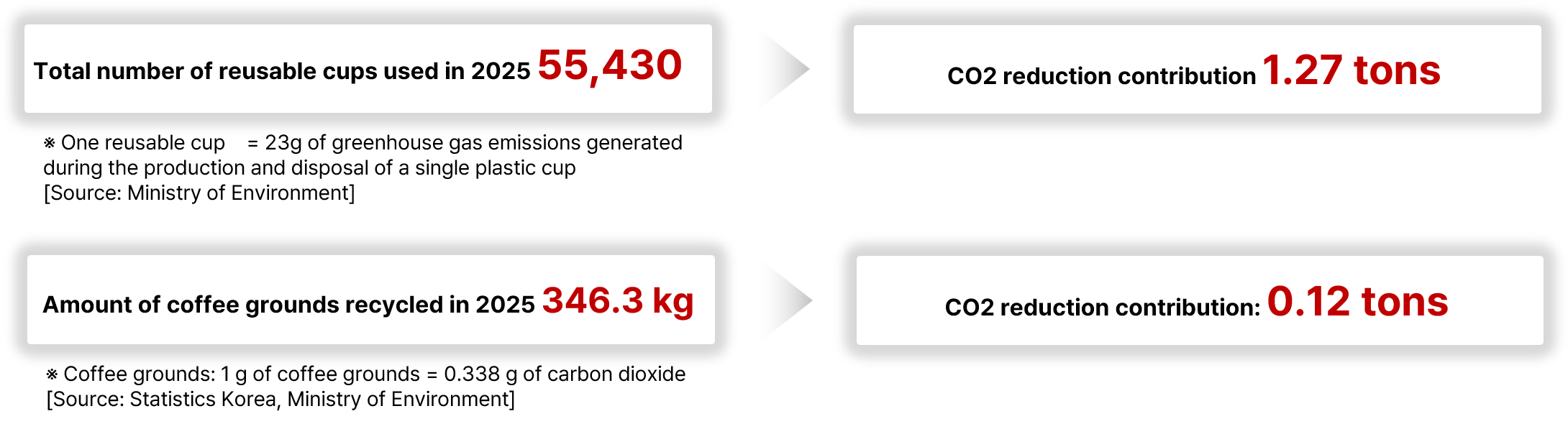
Hanmi Group uses reusable cups in employee lounges and cafeterias to reduce the use of disposable cups. The reusable cups are made from materials free of endocrine disruptors. Employees who use the cups return them to collection points, where they are collected and cleaned by a professional washing service from a local self-sufficiency center. In 2025, 55,430 reusable cups were used in the company cafeteria, resulting in an annual reduction of approximately 1.27 tons of greenhouse gas emissions. Furthermore, coffee grounds generated in the company cafeteria are not treated as general waste but are collected through the Songpa-gu Office's coffee grounds recycling program and provided to local livestock farms as a moisture regulator and compost. The expected greenhouse gas reduction contribution from coffee grounds recycling is 0.12 tons.
In-house 'Whole Soy Milk AGAIN' Campaign for Environment Day
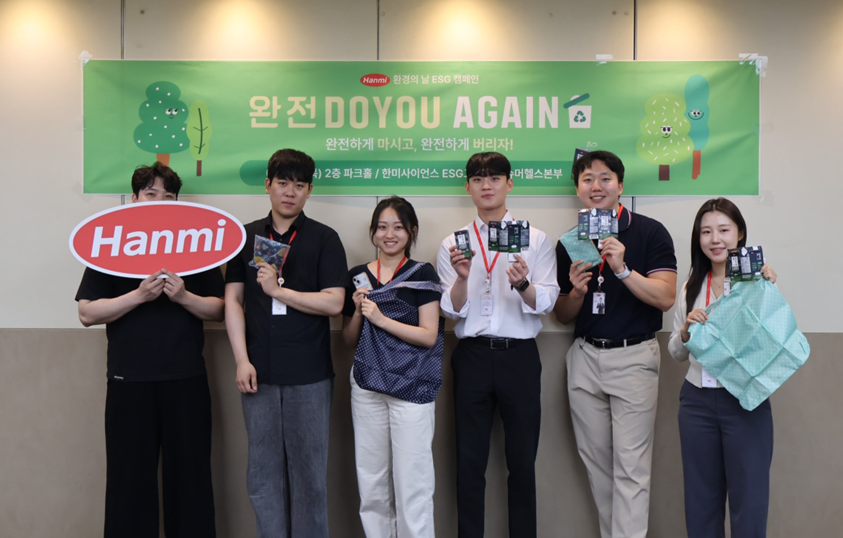
Hanmi Science conducted the 'Whole Soy Milk AGAIN' program for 'Environment Day'. Employees sampled the company's Whole Soy Milk products, received education on how to properly separate and dispose of aseptic packs, and directly experienced the washing, drying, and unfolding processes.
Approximately 100 employees participated, pledging to practice environmental protection for future generations. The campaign focused on guiding the correct disposal method for aseptic packs: ▲washing them cleanly, ▲completely removing moisture, ▲unfolding and drying the packs, and ▲disposing of them separately from general paper packs. Through this activity, Hanmi Pharmaceutical aims to raise employees' awareness of resource circulation and lay the groundwork for spreading sustainable environmental protection practices in daily life.
Donation Program for Disposed IT Assets
Hanmi Group recycles disposed IT assets to promote efficient resource circulation. In collaboration with the social enterprise 'Comwin', IT waste is recycled, and refurbished PCs are used to support IT education and initiatives for underprivileged groups.

III. Risk Management
Risk and Opportunity | Period | Target Audience | Method | Oversight |
|---|---|---|---|---|
Climate Change Response | ||||
GHG Monitoring and | Once a year | Hanmi Science | ㆍMonitoring of carbon neutrality roadmap through | ESG Group, |
GHG Reduction Activities | Once a year | Hanmi Science | ㆍMethods for reducing energy, water, and steam | Property Management Group, |
Financial Impact Analysis of Climate Change | Once a year | Hanmi Science | ㆍReview of negative impacts on business operations, | ESG Group |
Minimizing Environmental Impact | ||||
Pollutant Management | Ongoing | Hanmi Science | ㆍManagement of air/water pollutants below legal | Property Management Group, |
Hazardous Chemical | Ongoing | Hanmi Science | ㆍManagement of hazardous chemical use and disposal | Manufacturing Support Team |
Waste Management | Ongoing | Hanmi Science | ㆍMonitoring waste generation and recycling volume, | Property Management Group, |
Water Resource | Ongoing | Hanmi Science | ㆍManagement of water intake and wastewater discharge | Finance Group, |
Ⅳ. Indicators and Goals
Carbon Neutrality 2025 Performance and 2026 Targets
2025 Performance | 2026 Targets | |
|---|---|---|
ㆍGreenhouse gas emissions 10,836tCO2eq (10% increase compared to 2023) | ㆍGreenhouse gas emissions 9,814tCO2eq (maintained at 2023 level) | |
- [Company-wide] Establishment of GHG inventory management system | - [Head Office] Office lighting improvement and introduction of power | |
Carbon Neutrality Related Investment Amount
2025 | Execution Rate | 2026 |
|---|---|---|
Plan: KRW 2.46 billion1) l Executed: KRW 0.5 billion | 20% | Plan: KRW 2.69 billion |
Minimizing Environmental Impact 2025 Performance and 2026 Targets
2025 Performance | 2026 Targets |
|---|---|
Pollutant Management | |
ㆍAir/Water Pollutant Legal Emission Limits: 70%/60% or less | ㆍManagement of air/water pollutant legal permissible limits: 70%/60% or less |
Hazardous Chemical Management | |
ㆍDue to negligible generation of designated waste, no separate waste | ㆍManaging incineration rates of hazardous chemicals at 30% or less. |
Circular Economy Management | |
ㆍWater Withdrawal (Intensity): 98.8 tons/KRW 100 million | ㆍMaintain 2023 level of Water Withdrawal (Intensity): Below 110.8 tons |
Spreading Eco-friendly Culture | |
ㆍCarbon Neutrality Social Contribution Activities, such as using multi-use | ㆍPursuing a reduction effect of 2.0 tons or more annually through |
Investment Amount Related to Minimizing Environmental Impact
2025 | Executed: KRW 40 million |
|---|
Ⅴ. Climate Change Risk Analysis
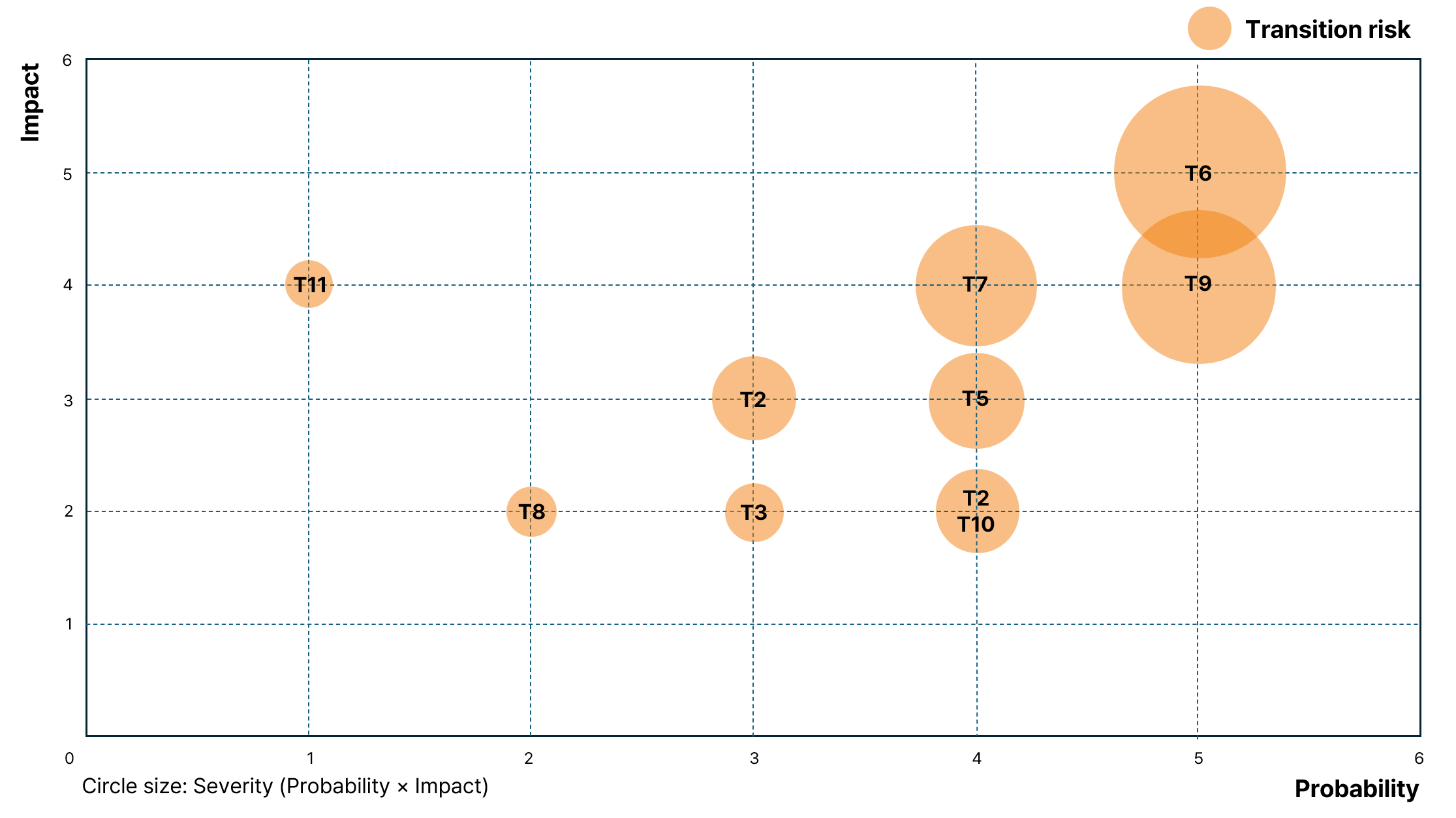
Hanmi Science conducted a comprehensive review of the negative impacts of business operations, external environmental changes, and financial implications in 2025 to identify climate change risks and opportunities. The assessed business sites and organizations identified and reviewed transition risks and opportunities, taking into account the likelihood of occurrence in the short, medium, and long term, as well as the severity of the company's potential impact. Moving forward, we plan to conduct climate change-related scenario analysis and systematically identify physical risks to advance our climate change response and risk management system.
Climate Change Risk Management Framework

Climate Change Risk Assessment
Category | Risk Description | Priority | ||
|---|---|---|---|---|
Transition Risk | Policy | T1 | Possibility of Inclusion in Greenhouse Gas Target Management System | 9 |
T2 | Expansion of Mandatory Climate Change Disclosure | 5 | ||
T3 | Prevention of Greenwashing | 8 | ||
T4 | Obligations and Regulations on Existing Products and Services | 6 | ||
Technology | T5 | Introduction of low-carbon technologies/facilities | 3 | |
Market | T6 | Power market uncertainty | 1 | |
T7 | LNG market uncertainty | 3 | ||
T8 | Uncertainty in supplier selection | 9 | ||
T9 | Increased volatility in renewable energy prices | 2 | ||
Reputation | T10 | Increased stakeholder concerns and negative feedback, such as changes in consumer preferences | 6 | |
Category | Risk Description | Priority | ||
Opportunity | Policy | O1 | Increased incentives for participating in carbon reduction | 3 |
Technology | O2 | Energy cost reduction through RE100 implementation by securing renewable energy and installing solar power | 1 | |
Reputation | O3 | Increased business competitiveness through climate change response (e.g., eco-friendly product production) | 2 | |
Key risks requiring priority management are highlighted.
Climate Change Transition Risk Assessment
Due to the expansion of production lines at the Songtan plant, the applicability of carbon emission-related regulations such as the Greenhouse Gas Target Management System is expected to increase in the future. Hanmi Science is building an environmental management system to respond to these transition risks, identifying risks in advance and establishing response strategies to minimize business risks that may arise during the 2040 Net Zero implementation process. Furthermore, the company plans to actively communicate various activities and achievements for reducing environmental impact with stakeholders.
Type | Period | Risk | Financial Impact | Mitigation Measures | |
|---|---|---|---|---|---|
Policy/ | T1 | Long | Potential Inclusion in Greenhouse Gas | - Penalties imposed for failure to | [Current Response Measures] |
T2 | Mid | Mandatory Climate Change Disclosure | - Increased costs for emission | [Current Response Measures] | |
T3 | Mid | Prevention of Greenwashing | - Penalties incurred in case of violation | [Current Response Measures] | |
T4 | Long | Obligations and Regulations on Existing Products and Services | - Increased compliance costs | [Current Response Measures] | |
Technology | T5 | Long | Introduction of Low-Carbon Technologies/Facilities | - Increased investment costs for | [Current Response Measures] |
Market | T6 | Short | Power Market Uncertainty | - Increased energy costs due to | [Current Response Measures] |
T7 | Short | LNG Market Uncertainty | - Due to potential increases in LNG | [Current Response Measures] | |
T8 | Long | Uncertainty in Supplier Selection | - Due to the use of sustainable raw | [Future Response Directions] | |
T9 | Long | Increased Renewable Energy Price Volatility | - Renewable energy self-generation, | [Current Response Measures] | |
Reputation | T10 | Long | Increased Stakeholder Concerns and Negative Feedback, including Changes in Consumer Preferences | - Establishing an LCA system for | [Current Response Measures] |
Assessment of Climate Change Opportunities
Hanmi Science evaluated climate change opportunities that could impact its business based on impact and likelihood, thereby deriving materiality.
Type | Period | Opportunities | Financial Impact | Response Measures |
|---|---|---|---|---|
Policy/ | Long | O1. Increased Incentives from Participating in Carbon Reduction | - Government subsidies/grants, tax benefits, | [Current Response Measures] |
Technology/ | Mid | O2. Energy cost reduction by achieving RE100 through securing renewable energy and installing solar power. | - Reduction in electricity costs through | [Current Response Measures] |
Reputation | Mid | O3. Enhanced business competitiveness through climate change response (e.g., eco-friendly product manufacturing). | - Increased sales due to meeting climate | [Current Response Measures] |
Financial Impact Analysis of Climate Change Transition Risks
Hanmi Science assessed the materiality (likelihood × impact) of identified transition risks to identify high-priority risks (High grade), and calculated financial impacts based on the average annual amount for short-term (2026–2027), medium-term (2028–2030), and long-term (2031–2040) periods. Furthermore, with the implementation of RE100, it is expected that the burden of costs for emission deficits will be mitigated in the long term through expanded use of renewable energy and utilization of RECs and PPAs, which have been identified as financial opportunities.
Type | Transition Risks |
|---|---|
Content | T5. Introduction of Low-Carbon Technologies/Facilities |
Financial Impact | Hanmi Science has established detailed carbon neutrality goals with the aim of achieving carbon neutrality by 2040. To achieve carbon neutrality, investment costs for implementing reduction measures such as energy efficiency and process optimization will increase. For this, implementation costs through solar power facility installation and maintenance were calculated. |
Financial Impact | Short-term (2026-2027): KRW 1.12 billion |
Content | T6. Electricity Market Uncertainty |
Financial Impact | Starting from the 4th planning period of the Greenhouse Gas Emission Trading Scheme, the proportion of paid emission allowances in the power generation sector is gradually increasing (from 10% in the 3rd planning period to a maximum of 50% by 2030 in the 4th planning period). With the push for electricity market reform, an increase in electricity unit prices is anticipated. Accordingly, energy costs due to rising electricity unit prices have been calculated. |
Financial Impact | Short-term (2026-2027): KRW 2.82 billion |
Content | T7. LNG Market Uncertainty |
Financial Impact | The possibility of rapid fluctuations in international LNG prices is expanding due to increased volatility from global political and climate factors, such as rising exchange rates, wars, and cold waves. Accordingly, the financial impact on energy costs was estimated by applying it to annual LNG consumption compared to BAU (Business As Usual). |
Financial Impact | Short-term (2026-2027): KRW 1.75 billion |
Content | T9. Increased Volatility in Renewable Energy Prices |
Financial Impact | Hanmi Science aims to achieve RE100 for Net Zero realization by 2040 and has set Power Purchase Agreements (PPA) and Renewable Energy Certificates (REC) purchases as primary implementation methods. The costs for RE100 implementation through PPA and REC, including annual KEPCO charges based on BAU, have been calculated. |
Financial Impact | RE100 Implementation Costs (PPA) |
Mid-term (2028-2030): KRW 3.04 billion | |
Financial Impact | RE100 Implementation Costs (REC) |
Mid-term (2028-2030): KRW 4.11 billion | |
Type | Opportunities |
Content | O2. Energy cost reduction by achieving RE100 through securing renewable energy and installing solar power. |
Financial Impact | Hanmi Science is reviewing the introduction of renewable energy PPA contracts to achieve RE100 for carbon neutrality, and through this, has compared and analyzed existing Korea Electric Power Corporation (KEPCO) electricity tariff rates with PPA rates. As a result of this analysis, the potential for reducing electricity purchase costs through PPA introduction was identified as a financial opportunity. |
Financial Impact | Mid-term (2028-2030): KRW 0.06 billion |